Prof. Ville-Pekka Mäkeläinen from Seinäjoki University, Finland will be teaching a Seminar on Business to Business Marketing February, 10th at 16,30 (Salón de Grados, Facultad de Ciencias Económicas y Empresariales, Universidad de Granada).
Professor Mäkeläinen is a Professor of International Marketing at
Seinäjoki University of Applied Science in Finland. He has a Lic. Tech.
degree in Industrial Engineering and Management from Lappeenranta
University of Technology. In addition to his work at Seinäjoki
University, he also teaches at California Polytechnic State University
and other universities in Europe as a visiting professor in
international marketing. Professor Mäkeläinen is fluent in Finnish,
English, German, Spanish and Swedish. He teaches business-to-business
marketing at UMSL.
Wednesday, January 29, 2014

Sunday, December 22, 2013
Seminar in Spanish: “El Director de Marketing 2.0, estrategias de marketing digital”
 El Jueves 31 de Enero de 2014, por la tarde, en la Facultad de C.C. Económicas y Empresariales, tendrá lugar la ponencia “El Director de Marketing 2.0, estrategias de marketing digital”, a cargo de D. Rubén Olmeda Gutiérrez, dentro del Máster Universitario en Economía/Economics.
MATERIA: Que los asistentes puedan comprender de una forma estructurada lo que necesitan las empresas hoy en día de un Director de Marketing. Las funciones que debe realizar y las estrategias que funcionan en las campañas online.
FECHA: 31 enero 2013 a las 5 y media de la tarde en el salón de grados
DURACIÓN: 4 Horas
BIO de D. Rubén Olmeda Gutiérrez:
Tras estudiar derecho en la UCM, realizó el Master en Dirección de Marketing y Gestión Comercial en ESIC
Ocupó las funciones de Director de Comunicación en AON.
Ejecutivo de Grandes Cuentas en la Agencia de Publicidad Peter Planning.
Ha sido Country Manager para la Agencia de Medios Mediagate en España.
Desde 2012, desarrolla proyectos online con las empresas Sullivan Marketing, Blogempresas.com y Open Space.
Es profesor en ESIC Madrid impartiendo los seminarios de “Marketing Digital” y “Social CRM”.
Sunday, May 5, 2013
Get ready with me for SRH Hochschule. By Marta Suárez-Varela Maciá
First Steps in Germany: Starting with the language.


If you want
to make the most of your stay in Berlin, learning German is one of the things
you should do. It is essential not only to understand the culture and the
people but also to find a job or an internship.
However, German
is not an easy language. Declesions, nominative, accusative, dative and genitive are some of the words that will give you more than a headache. With the
help of a good school, and a great deal of motivation, effort and patience, you
will finally achieve it.
Here are
some tips to find the school.
One of the
best options is a state institution called “Volkshochschule”. There are
twelve in Berlin, one in each of the districts, so you can always find one close
to your house. They offer a wide range of courses for every level from A1 to
C2. Normally each of the courses consists of 100 hours during around 5 weeks for
only 150€! Here you can find all the scheduled courses.
If you are
a complete beginner, you can also choose to do an Integration Course.
It takes 660 taught hours of which 600 are language teaching and 60 hours are
an orientation course. It is
divided divided into 6 modules (From level A1 to B1) and ends with a free final
examination. Each module costs 120€, but the good thing is that if you pass the final exam, you will be
given half of the total price you payed for the Integration Course.
However, if
you cannot devote so many hours to learn German, or you want to take it easy,
there are also plenty of private schools that offer more flexible timetables. These are some of the most recommendable ones:
v BSI Berlin.
Now you have all the information. You just have to choose the option that suits you best!
Friday, April 5, 2013
The SRH Hochschule Berlin University visits us!
During this
week, we have very special guests in our Master: our colleagues from Hochschule
Berlin.
Prof.
Victoria Büsch gave an interesting course entitled "Demographic Change,
Labor Market, Human Resource Management".

Then, Prof.
Bert Eichhorn gave a wonderful seminar about "EU as a role model for other
regions of the world?"

Here we go
Maria Barquier, a Master’s student that next course will study there in SRH
Berlin!

Here is all the Master's staff, enjoying a pleasant moment after work. Prof. Bert was
delighted with the Spanish desserts!

Thursday, April 4, 2013
What's about...? International Journal of Production Economics
By Cristina Alcaide & Carmen Olea
 The International Journal of Production Economics focuses all aspects of the subject in relation to manufacturing and process industries, as well as production in general. This journal is interdisciplinary in nature, considering whole cycles of activities, such as the product life cycle -research, design, development, test, launch, disposal -and the material flow cycle- supply, production, distribution. So the papers need to contain an essential novel scientific contribution. Moreover, the journal combines the high standards of a traditional academic approach with the practical value of industrial applications. In most papers, different models are developed to measure some areas of firms such as the production processes, supply chain and so on. Besides, researchers usually apply models like a case study.
The purpose of the journal is to disseminate knowledge for improving industrial practice and to strengthen the theoretical base necessary for supporting sound decision making. To sum up, the central themes of this journal are to trace economic and financial consequences in the analysis of the problem and solution reported.
Those are some methodologies that you can find in some papers
- Ordinary least squares
- Linear programming method
- Heuristic algorithm based on Lagrangian relaxation
- Stochastic dynamic programming
- Average Extra Quadratic Loss (AEQL) International Journal of Production Economics
- Automated Storage and Retrieval Systems (AS/RS)
- Lambert W function
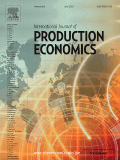 The International Journal of Production Economics focuses all aspects of the subject in relation to manufacturing and process industries, as well as production in general. This journal is interdisciplinary in nature, considering whole cycles of activities, such as the product life cycle -research, design, development, test, launch, disposal -and the material flow cycle- supply, production, distribution. So the papers need to contain an essential novel scientific contribution. Moreover, the journal combines the high standards of a traditional academic approach with the practical value of industrial applications. In most papers, different models are developed to measure some areas of firms such as the production processes, supply chain and so on. Besides, researchers usually apply models like a case study.
The purpose of the journal is to disseminate knowledge for improving industrial practice and to strengthen the theoretical base necessary for supporting sound decision making. To sum up, the central themes of this journal are to trace economic and financial consequences in the analysis of the problem and solution reported.
Those are some methodologies that you can find in some papers
- Ordinary least squares
- Linear programming method
- Heuristic algorithm based on Lagrangian relaxation
- Stochastic dynamic programming
- Average Extra Quadratic Loss (AEQL) International Journal of Production Economics
- Automated Storage and Retrieval Systems (AS/RS)
- Lambert W function
Tuesday, April 2, 2013
Subscribe to:
Posts (Atom)